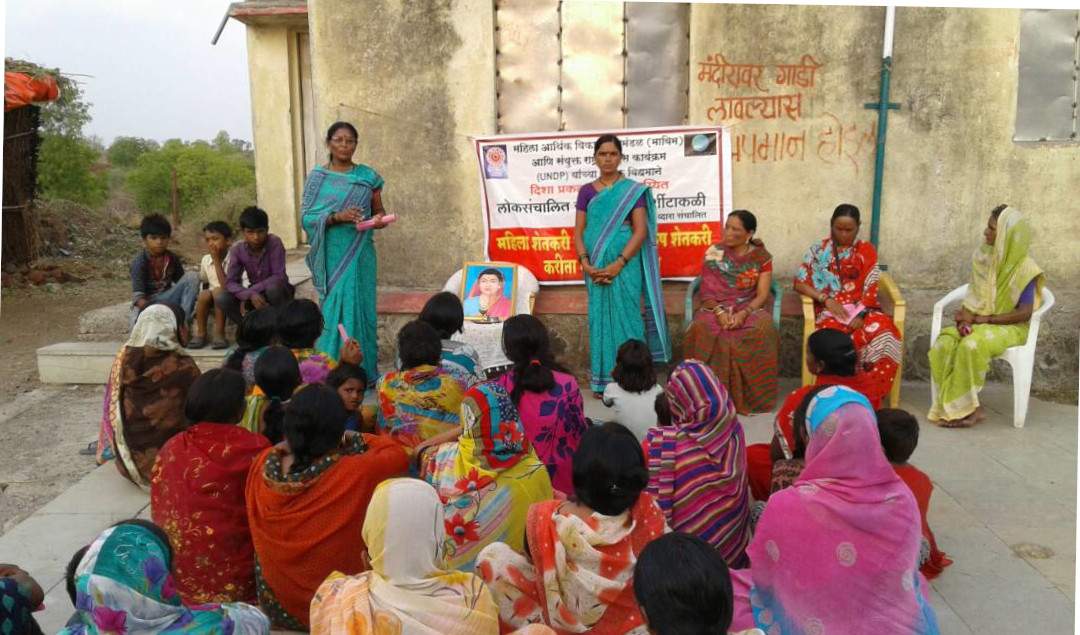
Mahila Arthik Vikas Mahamandal (MAVIM), a Government of Maharashtra organisation, has been relentlessly working for the socio-economic empowerment of women in the state through its widespread network of women’s self-help groups. The projects undertaken by the organisation have brought about a significant change in rural areas.
25th October marked a special day for the Mahila Arthik Vikas Mahamandal (MAVIM) when various products made by women’s self-help groups (SHG) from Maharashtra were made available for purchasing on Amazon, India’s leading e-commerce marketplace. This was the result of a unique partnership between MAVIM and Amazon India’s Saheli platform which handholds women entrepreneurs to market their products online. The product launch took place during the Shakti: Corporate Summit, jointly organised by MAVIM and Sahabhag, the Social Responsibility Cell of Government of Maharashtra.
The summit, held in Mumbai, was organised with an aim to leverage private sector support and expertise for women-led micro-enterprises in the state. Present dignitaries included Ms. Pankaja Munde, Minister of Women and Child Development and Mr. Yaakov Finkelstein, Consul General of Israel, as well as several representatives from the business community, Government, and civil society.
MAVIM was founded in 1975 to bring about gender justice and equality for women, investing in human capital and the capacity building of women, thus making them economically and socially empowered and enable them to access sustainable livelihoods. It is a not-for-profit corporation of the state government under the aegis of Women and Child Development Department.
MAVIM has done pioneering work in promoting microfinance and led the SHG movement in Maharashtra, leading to the formation of more than 1,14,000 SHGs till date. A vast majority of these SHGs is in rural areas. The unparalleled reach coupled with a strong grassroots connect has established MAVIM as a leading agent of social change.
A typical SHG comprises 10 women from a village, including a leader, who is responsible for maintaining the group’s records. MAVIM handholds women in crucial stages of SHG formation, such as, organising members, formalising the group, and training members in regular procedures. Members contribute a fixed amount to the group as monthly savings.
The corpus is held in a savings bank account of the collective. As need arises, members can borrow money from the corpus for domestic expenses, and repay it later at a small interest. Access to money can be tremendously helpful during emergencies, for example, a death in the family or for urgent medical treatment.
Also, assurance of credit enables women to plan for significant foreseeable expenditures such as a wedding or education. In regions with limited access to institutional finance, these lending networks provide low-income individuals an alternative to extortive moneylenders, avert sale of assets in times of distress, and prevent households from slipping into poverty. This is the essence of microfinance.
As groups gain experience and demonstrate savings discipline, MAVIM helps members undertake a wide variety of income generating activities suited for the pre-dominantly agricultural rural economy. Goatry, dairy, and poultry are the most popular vocations taken up by MAVIM women.
MAVIM SHGs are also engaged in a number of other activities such as household food manufacturing, agricultural processing, garment manufacturing, jewellery making, and various service jobs. In addition to training and handholding, MAVIM supports SHGs with access to bank loans for livelihood activities as well as market linkages wherever possible. These activities not only supplement the primary source of income in the households (mostly farming), but also empower women, raising their status within the families and society.
MAVIM’s interventions can be credited with bringing thousands of households out of poverty through women’s savings groups. A sign of success for microfinance in MAVIM is the changing nature of loans availed by its SHGs. It has been observed that as groups mature, the share of loans for livelihood-related activities goes up as against loans for consumption. The total amount in loans taken by MAVIM SHGs is ₹ 2,122 crore. MAVIM takes pride in the impressive repayment rate of 98% for loans availed by its SHGs. This affirms the notion that rural women are credible borrowers, and can be successful entrepreneurs.
One of the key strengths of MAVIM is its vast network of grassroots organisations known as Community Managed Resource Centres (CMRC), which perform the role of local implementing agencies for MAVIM’s programmes. The CMRCs are the bridge between MAVIM and individual SHGs and cater to them with a wide range of services, including bank linkages and capacity building trainings. A CMRC is essentially a taluka-level federation of 200–250 SHGs.
CMRCs were established as part of the Tejaswini programme (2007–2017), jointly funded by the International Fund for Agricultural Development (IFAD) and the Government of Maharashtra.
Although MAVIM was instrumental in formation of the CMRCs, they are independent institutions registered under the Societies Act. This allows a CMRC to adapt to local conditions and generate additional sources of revenue to sustain its operations and possibly earn a profit for its members.
Throughout the state, the CMRCs are engaged in small and medium-scale business activities which would be infeasible for individual SHGs, such as running dal mills, hatcheries, farm equipment lending centres, agriculture inputs stores, common facility centres, and trading and marketing of agricultural commodities.
Despite their resilience, SHGs face persistent bottlenecks in scaling up their economic activities and transforming into sustainable businesses. These include lack of access to credit, relevant skills, and exposure to markets. In light of these challenges, the private sector can be a valuable partner for MAVIM and the thousands of women entrepreneurs associated with the organisation. Businesses can invest in women-led enterprises and make them a part of their supply chains. Businesses can play a vital role in strengthening these micro-enterprises by contributing expertise in technology, management, and marketing know-how, while benefitting from access to a network of thousands of hardworking women. Going beyond philanthropy, a business case can be made for organisations to get associated with MAVIM. In recent years, MAVIM has actively collaborated with for-profit organisations and created livelihood opportunities for rural women in various sectors including agri-business, banking and finance, retail, and clothing and apparel.
MAVIM’s engagements with the private sector show the way forward for other development organisations working for women’s empowerment to thrive in the modern economy.
This article was originally published in the December 2018 issue of Maharashtra Ahead.